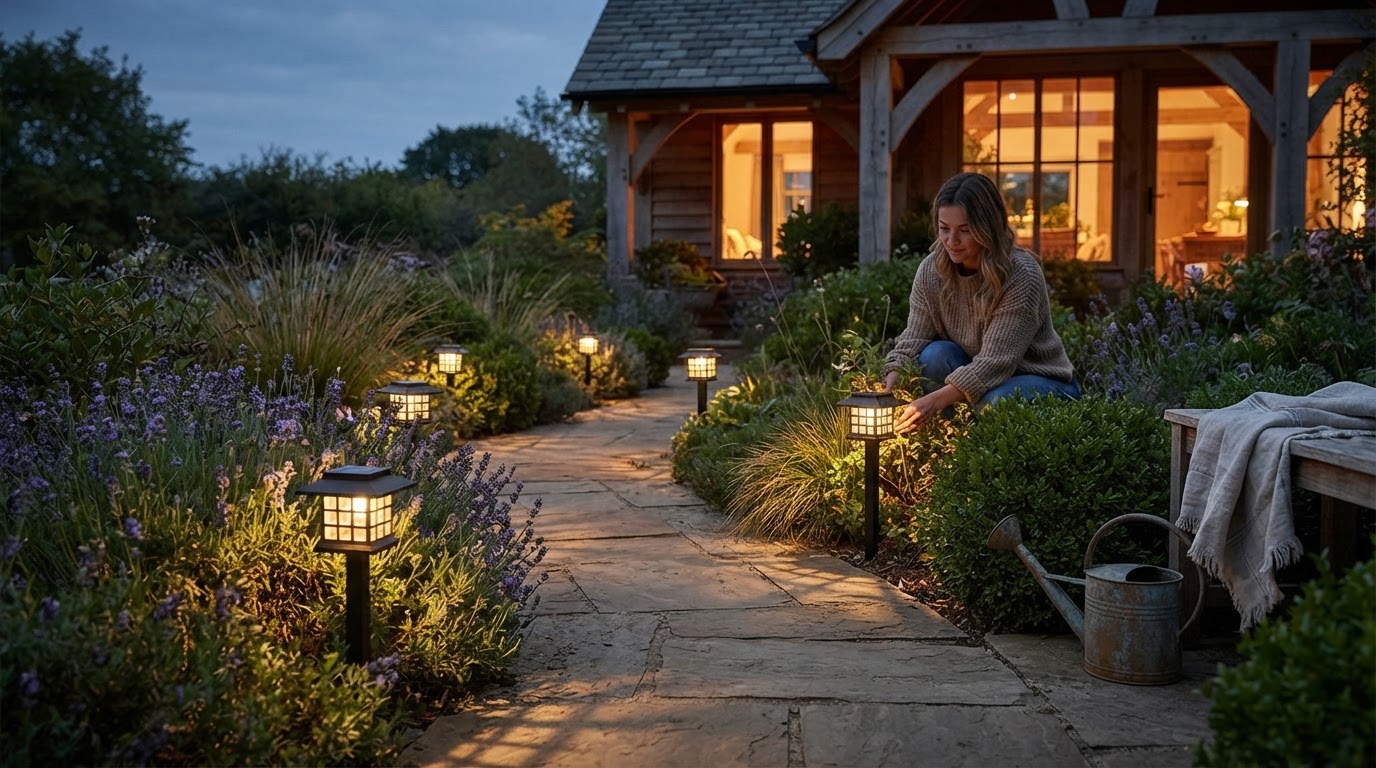
Solar Yard Glow Performance and Dusk to Dawn Utility
 Maya ChenContributing Editor
October 20, 2026 — The shift toward autonomous outdoor lighting has accelerated with the release of Solar Yard Glow, a system designed to bypass manual switching through integrated photocell technology.
The conventional wisdom says that solar lighting is a compromise between convenience and consistent output, often failing to reach the early morning hours. However, current industry benchmarks from Superior Lighting indicate that high-quality solar LED units can now sustain 8 to 10 hours of continuous illumination on a single charge. Solar Yard Glow enters this market by prioritizing the dusk-to-dawn cycle, aiming to provide a reliable baseline of visibility without the wiring overhead of traditional low-voltage systems.
The Efficiency Standard for Residential Security
Here's the part nobody talks about: the sheer physics of battery density versus light output. Most consumers expect a solar lamp to behave like a 60-watt incandescent bulb, but the reality is dictated by the efficiency of the photovoltaic panel and the capacity of the internal lithium-ion cell. Solar Yard Glow utilizes a high-conversion monocrystalline panel to charge during daylight hours, feeding a sensor that triggers the LED array once ambient light drops below a specific lux threshold. While other market options, such as those reviewed by AQ Lighting Group, may offer roughly 6 hours of operation, Solar Yard Glow is engineered to push further into the night.
Run the math: for a lamp to be truly useful for security, it must maintain a consistent lumen output from the moment the sun sets until the first light of morning. This requires a delicate balance between the 5000K daylight color temperature often found in security-grade fixtures and the energy consumption of the LED driver. Understanding how do Solar Yard Glow dusk to dawn lamps function is critical for homeowners who need to verify if their specific placement receives enough peak sun hours to fully saturate the battery. If the panel is shaded for even two hours of peak solar window, the dusk-to-dawn promise becomes a dusk-to-midnight reality. When optimizing residential security with Solar Yard Glow, placement is not just an aesthetic choice; it is a technical requirement for the photocell to operate within its designed parameters. I’ll change my mind when I see a residential solar lamp that can maintain 1000 lumens for 12 hours straight in mid-winter conditions, but for now, the current iteration of Solar Yard Glow represents the upper tier of what is physically possible with current solar cell technology.
Expert tip: To maximize the lifespan of the internal battery, ensure the solar panel is cleaned with a damp cloth every thirty days to prevent dust buildup from reducing charging efficiency by up to 20%.
Users should consult the Solar Yard Glow setup for reliable dusk to dawn lighting to ensure the sensors are not triggered by secondary light sources like streetlamps. Furthermore, determining is Solar Yard Glow better than other dusk to dawn lamps requires a direct look at the discharge rates compared to cheaper, generic alternatives that often lack weather-sealed housing.
Sources
Photo by Marek Piwnicki on Pexels
- Solar Dusk-to-Dawn Light, 1000 lm, Pole Mount, 5000K
- Solar Powered LED String Light – Dusk to Dawn, Outdoor Rated
- Top 5 Best Solar-Powered Dusk-to-Dawn Lights of (2026)