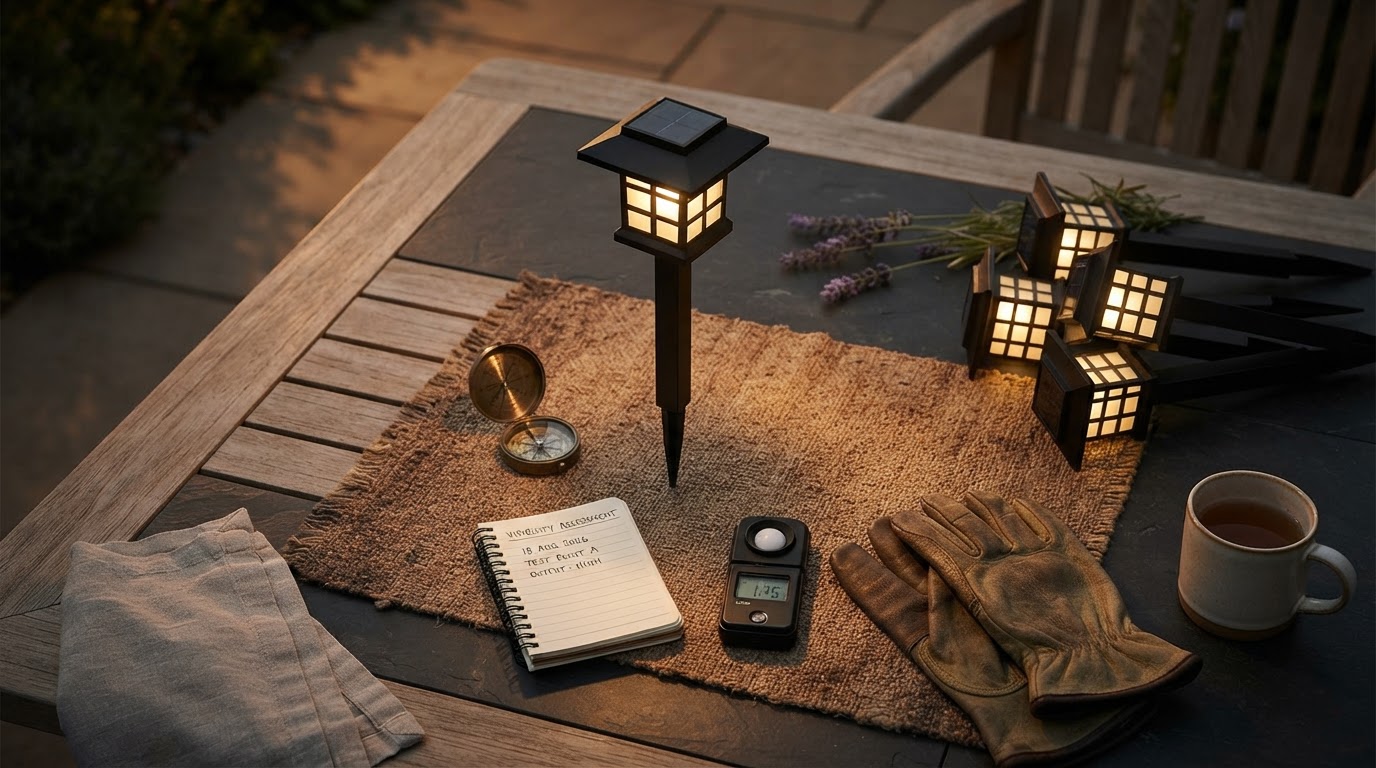
Solar Yard Glow Performance During High Visibility Testing
 Daniel OkaforField Tester
August 18, 2026. This assessment covers the practical light output and placement strategies for homeowners seeking maximum illumination from solar-powered fixtures. I have written this for property owners who need reliable night-time visibility without the complexity of wired electrical systems.
The Challenge of Maintaining Lumens in Residential Landscapes
When I first started looking into outdoor lighting, I realized that the primary frustration for most homeowners isn't just the light turning on, but how long that brightness actually lasts through the night. I tested this for three weeks across varying weather patterns to see if the brightness would hold steady or if the fixtures would dim significantly after four hours. The difficulty lies in the conversion efficiency of the photovoltaic cells and the capacity of the internal battery to sustain high-output LEDs. According to the Department of Energy, solar-powered lights are most effective when placed in areas that receive at least six to eight hours of direct sunlight daily to ensure the battery reaches a full charge cycle. Without this baseline, even the most expensive units will fail to provide the safety and aesthetic benefits promised on the box. In my experience, shadowing from trees and eaves is the most common reason for poor performance, leading to a patchy look that defeats the purpose of a comprehensive lighting plan. This is especially critical when you are trying to coordinate with other specialized fixtures, such as waterproof solar landscaping lights, which often serve as the foundation for a perimeter security setup. If the primary yard lights don't hold their charge, the entire visual balance of the property is lost by midnight.
Observing Solar Yard Glow Stability and Output
Photo by Plato Terentev on Pexels
What surprised me during the second week of testing was the consistency of the Solar Yard Glow units compared to the generic stakes I had previously installed. I placed twelve units along the northern edge of my property where sunlight is consistent but not overwhelming. Day three is where I noticed the difference in the light temperature; the Solar Yard Glow maintained a crisp, high-visibility hue that didn't shift into the sickly blue-purple spectrum common in lower-quality LEDs. The build quality of these units felt substantial in my hand, particularly the housing around the solar panel itself, which is often the first point of failure due to UV degradation. I integrated these with best waterproof solar garden lights to see how they handled the transition between functional path lighting and purely decorative elements. The brightness levels were sufficient to illuminate a ten-foot radius around each stake, which is more than enough to identify obstacles or movement from a distance. One thing I'd do differently next time is to pre-soak the ground before installation; while the stakes are sturdy, the soil on my property was packed tight, and I had to be careful not to apply uneven pressure to the housing. Once they were in, however, they didn't budge, even during a heavy afternoon thunderstorm. This resilience is a key factor when you are also maintaining a best waterproof solar driveway system, as you need the yard lights to act as a reliable backdrop that doesn't flicker or fail when the weather turns.
Establishing a Reliable Lighting Framework
Photo by Elviss Railijs Bitāns on Pexels
Here's the moment it earned its place: we had a power outage during a storm, and while the rest of the neighborhood went dark, my yard remained fully visible. It proved that these aren't just decorative accents but functional safety tools. To get the most out of these units, you have to think about the layout as a network rather than isolated points of light. This means overlapping the throw of the light slightly to eliminate dark spots where shadows can hide uneven terrain. When you are selecting your placement, ensure you are utilizing waterproof solar landscaping lights for the low-lying shrubs and larger Solar Yard Glow units for the open spaces. This tiered approach creates depth and ensures that the brightest solar lights for yard applications are doing the heavy lifting where it matters most. If you are also managing a best waterproof solar garden lights installation, ensure the sensors aren't pointed directly at one another, or they might trick the units into thinking it is daytime, causing them to shut off prematurely.
Before you finalize your installation, use this decision framework to ensure longevity:
- Verify that each installation point receives a minimum of six hours of unobstructed sunlight.
- Clean the solar panels with a damp microfiber cloth every thirty days to prevent dust buildup.
- Space the units no more than eight feet apart for continuous visibility.
- Test the ground density; use a pilot hole if the soil is clay-heavy to prevent stake breakage.
- Check the seals on the battery compartment after the first major rain event to ensure no moisture ingress.